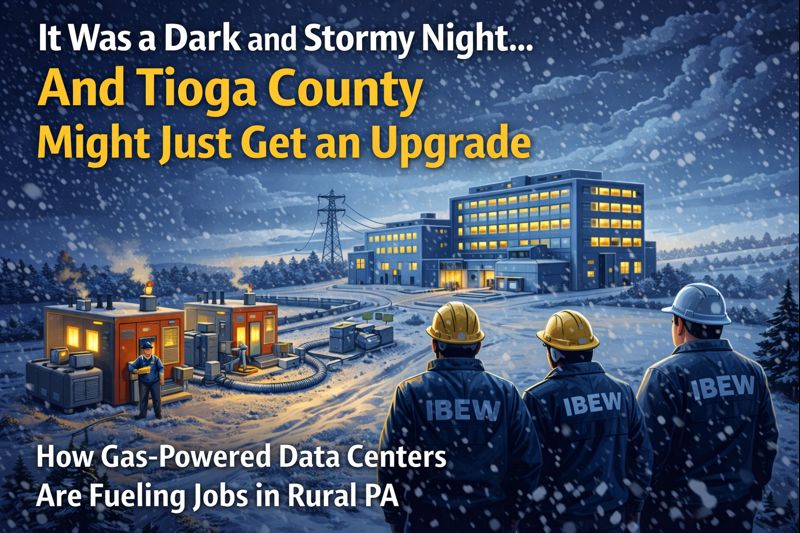
…And Tioga County Might Just Get an Upgrade
It was a dark and stormy night. I always wanted to open an article with that line, and if my editors don’t eye-roll and cringe, I’ll be doing great. But in this case, it wasn’t just a literary indulgence — it was Tioga County in the middle of winter. Snow whipped sideways. Visibility was nearly zero, and the wind cut across the hills with a personal grudge against anyone outside.
Up here, we’re made for stormy weather. We don’t need saving. What we do need is a little upgrade.
Because when the weather turns, and the smartphone dims, -the lights jerk auditioning for a horror movie – then you think about power. Anyone who’s lived through enough winters knows the grid has its quirks. In April 2025, state Sen. Gene Yaw made it official: Pennsylvania’s power generators are “screwed,” not just the wires. He warned the system could face serious challenges in the next five to seven years — and that’s before you stack rising data demand on top of everything else.
That’s why the proposed data center on UGI land in Middlebury Center isn’t just another development to scroll past. It’s a bigger piece in a bigger story about power, jobs, and rural America in an AI-hungry world.
Pennsylvania’s Data Center Boom
Pennsylvania isn’t just seeing occasional data center proposals — it’s becoming a real hub, especially for gas-powered data centers. Between March 2024 and March 2025, the state’s data center capacity grew by roughly 2.4 gigawatts as companies raced to support cloud and AI workloads. (PHILADELPHIA.Today)
Massive projects are already taking shape here, too. A $10 billion plan will transform the former Homer City coal plant into a 4.5 GW gas-to-AI campus — enough power to light millions of homes — and other large facilities are planned across the Commonwealth. (Inquirer.com)
Pennsylvania’s advantages are clear to developers: abundant natural gas, existing infrastructure, and a location that keeps data close to the East Coast markets hungry for high-performance computing.
Why Locals Should Care
At first glance, a data center sounds like a building you don’t notice until your internet slows. But this one — the UGI site in Middlebury Center — comes with answers to the questions every rural county asks when a big project rolls in:
Does it pay?
Yes. Construction of large data centers means skilled, union work, especially from IBEW electricians, many living within an hour of the site. Over a typical two-year build, analysts estimate as much as $70 million in local economic impact — rent, hotels, diners, hardware stores, fuel sales, supply shops — from wages spent right here. These are not the guys who come wire up your stove.
Is it permanent?
Construction is temporary — fair point, and the critics are right to say it. But temporary work at high wages ($40–$55/hour base, $70–$90+ with benefits and overtime) isn’t chump change. You can turn that moment into longer-term gain by recruiting workers to stay. This could fix what Pennsylvania refers to as, “The brain drain”. and that’s exactly what smart rural communities have done when they see these projects. The shrinking population rural Pennsylvania faces north of route 80.
What about long-term jobs?
Here’s where many folks get it wrong: data centers don’t employ armies once they’re running, but they do create ongoing technical roles. A facility with on-site generators and closed-loop cooling systems needs staff who know power systems, cooling infrastructure, electrical controls, and facilities maintenance — not minimum-wage labor. National data shows data center technicians average around $74,000/year, and experienced specialists often make more. These are career-level technical roles that stick around for years — possibly decades.
Does it stress water or energy?
Large, centralized data centers historically used lots of water for cooling, but this project’s closed-loop system recycles water, reducing fresh withdrawals — a big deal in areas reliant on private wells and streams. And while the site will connect to the regional grid for backup, its own natural gas-powered generators mean it can stay running when the broader system stutters — a reassuring thought after Yaw’s blunt assessment.
And yes: the grid will need upgrades to handle big data center loads, but local leaders can and should negotiate that developers pay for the infrastructure improvements, not local taxpayers.
The Bigger Picture
Pennsylvania’s embrace of data centers is more than local chatter. The Commonwealth is attracting billions in investment, including major campus projects that link natural gas generation with hyperscale AI workloads — part of a national trend as cloud platforms expand. (PHILADELPHIA.Today)
Not everyone is thrilled. Across the state, residents raise concerns about energy costs, water use, and environmental impacts, and survey comments show as much skepticism as enthusiasm. Some worry rates could climb, others fret about water table effects, and a number are skeptical about jobs. But even many critics acknowledge reality: data centers are coming, whether we like it or not, so rural communities have a choice — shape the deal or get run over by it.
So What’s the Real Deal for Tioga?
This isn’t a monument to Big Tech. It’s a potential shot in the arm for an economy that’s been scraping by — a place where young workers leave, where average wages lag, and where the next big employer is more dream than fact.
If done right, the Middlebury Center data facility and other rural towns could mean:
- Strong, union paychecks flowing locally
- Technical careers that stay long past construction
- A reason for people to move here, not leave here
- Modern grid infrastructure that benefits residents
- A bridge between rural energy resources and the digital economy
We didn’t need saving. Not really. But we sure could use a little upgrade. And if that upgrade comes in the form of a **humming generator on a winter storm night, staffed by workers who spend their paychecks in town — and maybe raise families here — then that’s not just infrastructure. That’s a future worth building.