
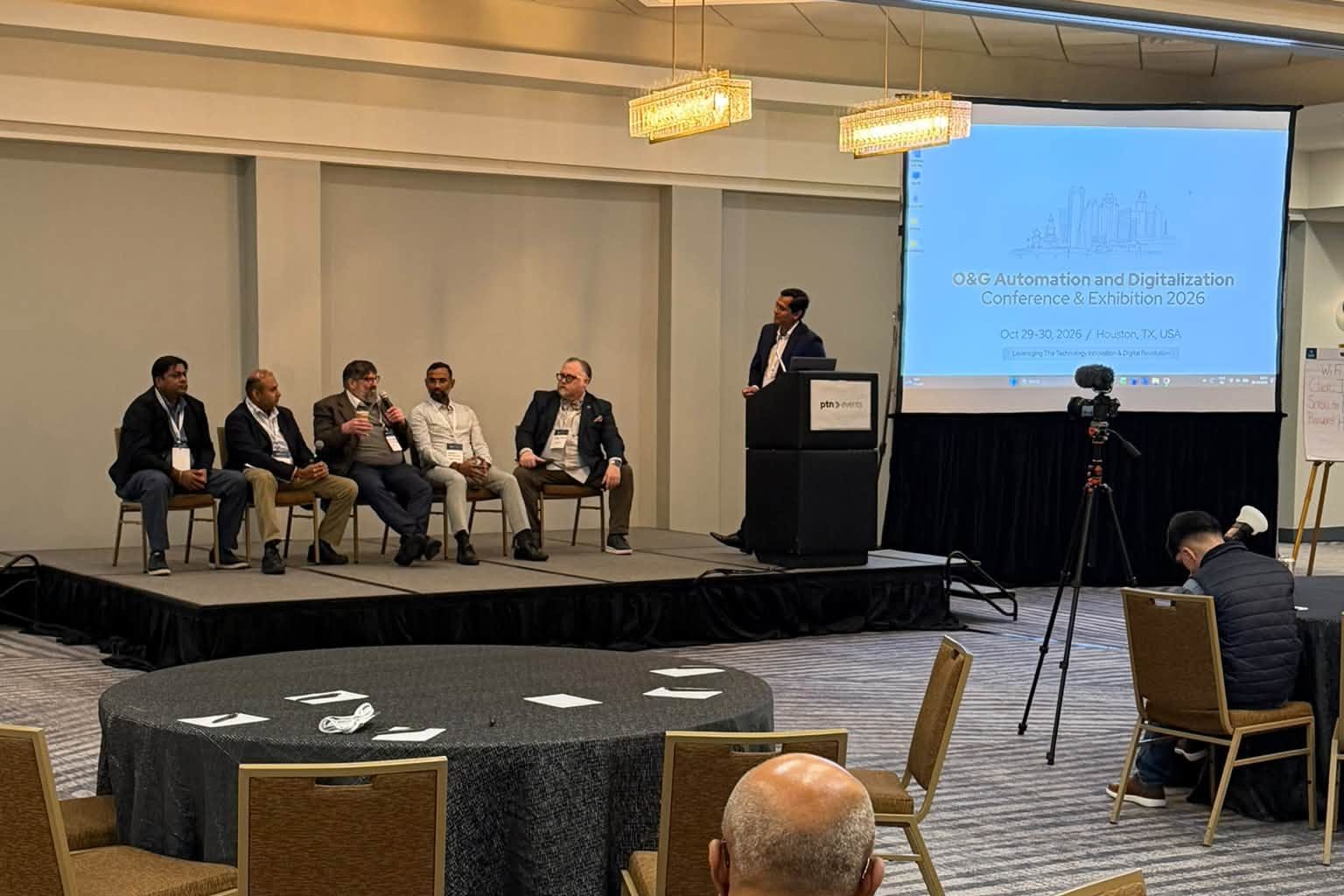
I spent Thursday and Friday, October 29 and 30, at the Crowne Plaza Houston Med Center on an OGGN press pass for the Oil & Gas Automation and Digitalization Conference, OGAD for short. PTN Events runs it as a single track of 30-minute talks over two days, so the whole room hears the same sessions, and the conversation at the coffee station picks up wherever the last speaker left off.
If you’ve sat through enough automation events, you know the worry going in: a day of dashboards and a demo that only works on the projector. That’s not what the OGAD agenda looked like. Read the titles on it. They Didn’t Hack In, They Logged In. Go-Live Is Day One. Insight Isn’t Enough. Industrial AI Without Accountability. Where I quote a session below, the words come from the descriptions PTN published with the agenda, so you can look any of them up.
Who was on the OGAD 2026 program?
Operators, equipment makers, cybersecurity firms, consultancies and a former Shell operational excellence advisor. These are the sessions I come back to in this piece, as PTN Events listed them in its agenda dated October 27.
| Slot | Speaker | Company | Session |
|---|---|---|---|
| Thu. 10:00 a.m. | Christopher Hills | BeyondTrust | They Didn’t Hack In, They Logged In |
| Thu. 10:30 a.m. | Merina Leong | Ironsight | Turning Data to Action |
| Thu. 1:00 p.m. | Ammar Sabbagh | Ericsson | Fence-to-Fence Connectivity |
| Thu. 1:30 p.m. | Steve Senterfit | Smartbridge | Industrial AI Without Accountability |
| Thu. 2:00 p.m. | Sonia Clayton | Virtual Intelligence Providers | AI PEOPLE Transformation |
| Thu. 3:00 p.m. | Miras Muratov | ScaleApp | From Prompt to Plant |
| Fri. 9:00 a.m. | Robert Macaulay | Baker Hughes | From Reactive Maintenance to Predictive Operations |
| Fri. 9:30 a.m. | Marc Berger | Everllence | Bridging the Physical and Digital World |
| Fri. 10:00 a.m. | Daniel Bartucci | Owl Cyber Defense | Rethinking Data Movement in Oil & Gas |
| Fri. 11:00 a.m. | Ajith Murthy | Formerly Shell | Data Fracking |
| Fri. 1:00 p.m. | Leslie Ellis | Meaningful Change Consulting | Go-Live Is Day One |
| Fri. 1:30 p.m. | Rafael Paura | ExxonMobil | Business Transformation for Large Corporations: Where Testing Connects |
| Fri. 2:00 p.m. | Panel | Smartbridge, Moran Shipping Agencies, Capgemini, ValueMomentum, CGI, Audubon | Investing in Digitalization: AI/ML, IoT, Big Data, Wearables, Cybersecurity and More |
| Fri. 3:30 p.m. | Sean Barnes | Wolf Executives | Leading Through Digital Transformation |
| Fri. 4:00 p.m. | Pratik Mahajan | JP Morgan | Insight Isn’t Enough: Engineering Trust in the Age of AI Analytics |
What happens after go-live?
Leslie Ellis, CEO of Meaningful Change Consulting, had the first slot after lunch on Friday, and her title does a lot of the work: Go-Live Is Day One: Three Leadership Moves That Turn Oil and Gas AI Investment Into Field Results. Her description covers the hidden costs that eat into the returns people expected, the field-level behaviors that tell you whether a new AI workflow is really being adopted, and the leadership routines that turn it into how the crew works every day. It ends right where I’d want it to. Measure AI initiatives against tangible operational outcomes, “rather than technology deployment alone.”
She had company. On Thursday, Steve Senterfit, president of Smartbridge, brought more than 30 years across energy and technology, including global leadership roles at Halliburton Landmark Services, to a talk on accountability. His description puts it plainly: “Without clear ownership, governance, operational alignment, and measurable business outcomes, AI initiatives often remain disconnected pilots rather than enterprise-wide drivers of performance.” Sonia Clayton of Virtual Intelligence Providers argued that successful transformation depends on “leadership, trust, culture, and workforce readiness, not technology alone.” And late Friday, Sean Barnes of Wolf Executives talked about leaders who can connect technical innovation with organizational strategy, establish accountability and build trust.
My read after two days: AI readiness comes down to AI literacy, AI fluency and trust. Literacy is knowing what the tool is doing and where it can be wrong. Fluency is using it in the daily work without a training binder open next to you. Trust is whether the crew will act on what it says. You can train the first two. Trust you have to earn, one right answer at a time.
That’s the part that gets skipped. Getting the system switched on is the easy day. The hard part is month three, when the field crew either trusts it or quietly goes back to the spreadsheet.
What’s it worth, and can you prove it?
One number got repeated enough that I went and checked it afterward: operators expect about $2.80 back for every dollar they put in. It holds up, with one footnote. It comes from EY’s survey of more than 200 upstream oil and gas decision-makers, taken in March and April 2026, and it’s $2.80 of value for every dollar spent on digital solutions overall, not AI alone. EY counts that value as added revenue plus lower costs.
The other number I came home with was $800 billion going into AI and digitalization over the next ten years. That one needs a correction. EY’s estimate is that digital solutions could add more than $790 billion of value in upstream over the next ten years. That’s value created, not money invested. EY puts the actual spend at about $24 billion in 2026, growing to $38 billion by 2035. Rystad Energy lands in the same neighborhood from a different angle, estimating close to $500 billion of cumulative value between 2026 and 2030 for exploration and production companies investing in digital and AI. Both are the firms’ own projections, not booked results.
The catch is the baseline. A lot of pilots never set a good one, so when the pilot wraps up, the outcome is difficult to measure. If nobody wrote down what a truck dispatch or a maintenance callout cost before the tool went in, nobody can credibly claim a savings after. The EY report quotes a former data science and analytics executive at an integrated E&P company saying it straight: “Measuring the ROI of digital solutions is hard.” L.E.K. Consulting’s study of more than 300 senior executives across oil and gas, utilities and renewables found the same gap, with some companies that “apply it broadly yet struggle to quantify the impact.”
So write the baseline down before you start. It’s the cheapest step in the whole project, and it’s the one that decides whether anybody believes the number at the end.
Where does the data come from?
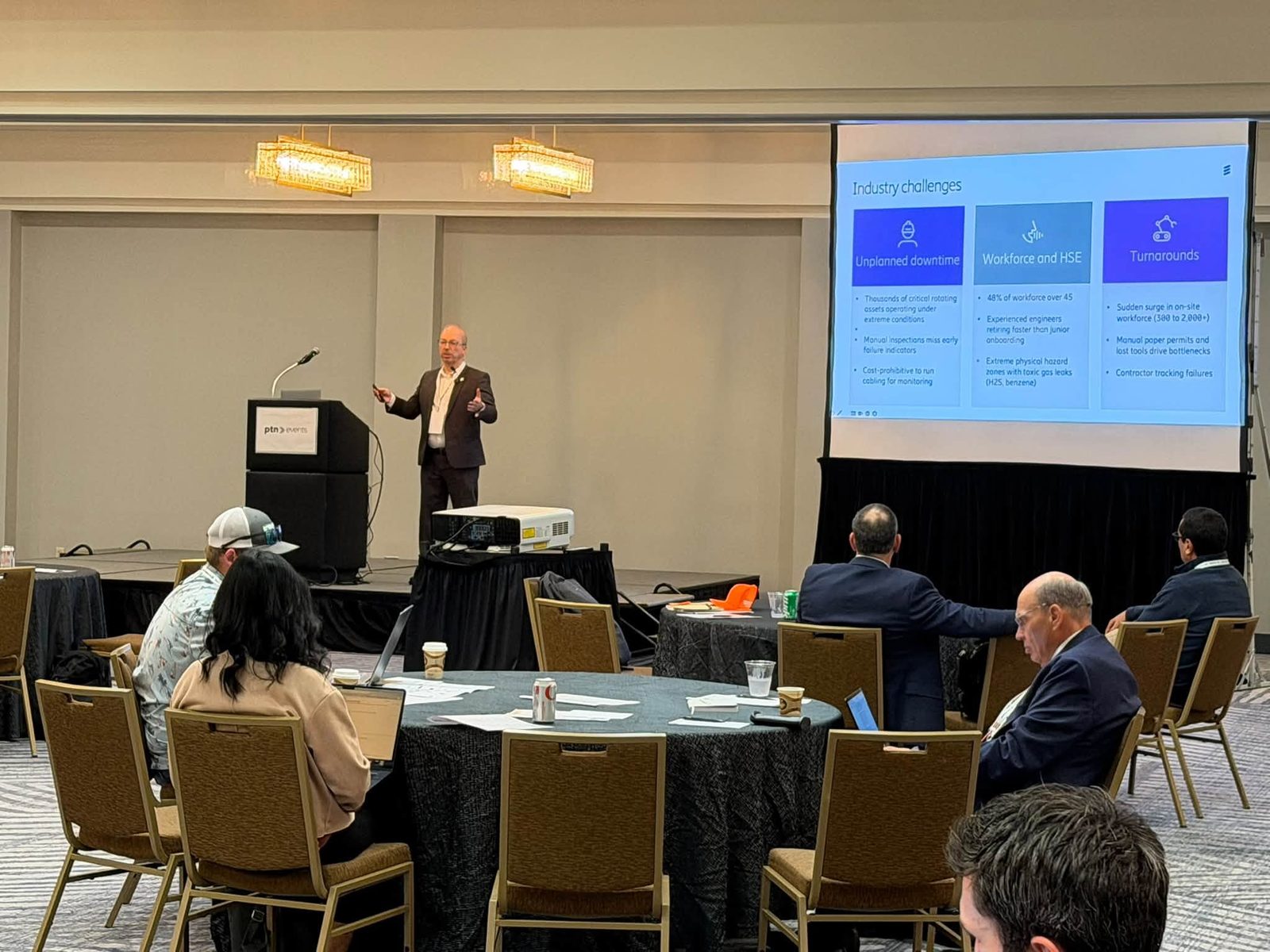
On Thursday afternoon the program went a step further back, to whether the data can get off the asset at all. Ammar Sabbagh of Ericsson had the 1:00 slot with Fence-to-fence connectivity: Connecting every asset, every operation, every opportunity. One of his slides put three industry problems side by side: unplanned downtime, workforce and HSE, and turnarounds. Under unplanned downtime, two bullets sat next to each other. Manual inspections miss early failure indicators, and running cable for monitoring is cost-prohibitive. Look, anybody who has priced a trench across a facility knows that second one.
The title I liked best on Friday was Ajith Murthy’s at 11:00, Data Fracking: Unlocking Document Intelligence for Operational Excellence. The agenda lists him as an operational excellence advisor, formerly of Shell. His description calls document fragmentation a major barrier to intelligent oil and gas operations, and it pitches “data fracking” as the way to extract and contextualize the knowledge sitting in legacy documents, then connect it to digital twins, agentic AI and other operational applications. It also draws a clean line between the data foundation and the intelligence layer built on top of it.
I love the metaphor, and not just because it’s clever. Data hygiene is a big issue for a lot of companies internally and externally, and a lot of the most useful operating knowledge in this business lives in documents that were never built to talk to each other. The value’s in the rock. It just doesn’t flow until somebody stimulates it.
Clean data ran under almost everything else on the program. Prediction and forecasting models are only as good as the history you feed them, and agentic workflows raise the stakes, because an agent acts on whatever it pulls back. In this business a lot of that history doesn’t live in a tidy database. It lives in scanned well files, drawings, inspection reports, tables buried in PDFs and handwritten logs. So the bottleneck to unlocking AI usually isn’t the model. It’s three things underneath it. Multimodal access to those documents, meaning the tables, drawings and images and not just the text. Extraction reliable enough to pull the right number out of the right table. And recall that finds the right document every time somebody asks. If retrieval misses the one inspection report that matters, the agent still answers. It just answers from half the picture.
The surveys point the same way. In Novi Labs’ survey of more than 150 U.S. reservoir engineers, poor data quality was the number one barrier to AI adoption, and 84% reported challenges with the quality and accessibility of upstream public data, up from 76% a year earlier. L.E.K. puts data quality limitations among the three barriers its respondents named most, alongside workflow integration and governance gaps. EY’s respondents ranked integration with legacy systems and infrastructure as their top challenge, at 45%, and EY notes that data is often stuck inside individual applications where it can’t be shared. None of those surveys breaks out documents on their own, so that piece is my read, and Murthy’s.
Rafael Paura, a portfolio manager at ExxonMobil, picked up the same thread at 1:30 from the other end, with testing as a strategic enabler, end-to-end process integrity and data quality and migration readiness. It’s not a glamorous topic, and I was glad to see it on the program anyway. If a migration goes in dirty, every model downstream inherits the mess.
Who has the keys?
Christopher Hills, chief security strategist at BeyondTrust, had my favorite opening line on the whole agenda for his Thursday talk, They Didn’t Hack In, They Logged In: “The most consequential OT incidents of the last few years didn’t start with an exotic zero-day; they started with access that was already there.” Per the description, he walked a real 2026 attack chain next to an AI-driven failure from the same month with the same root cause, and closed on five control categories that would have stopped both, with no new technology required.
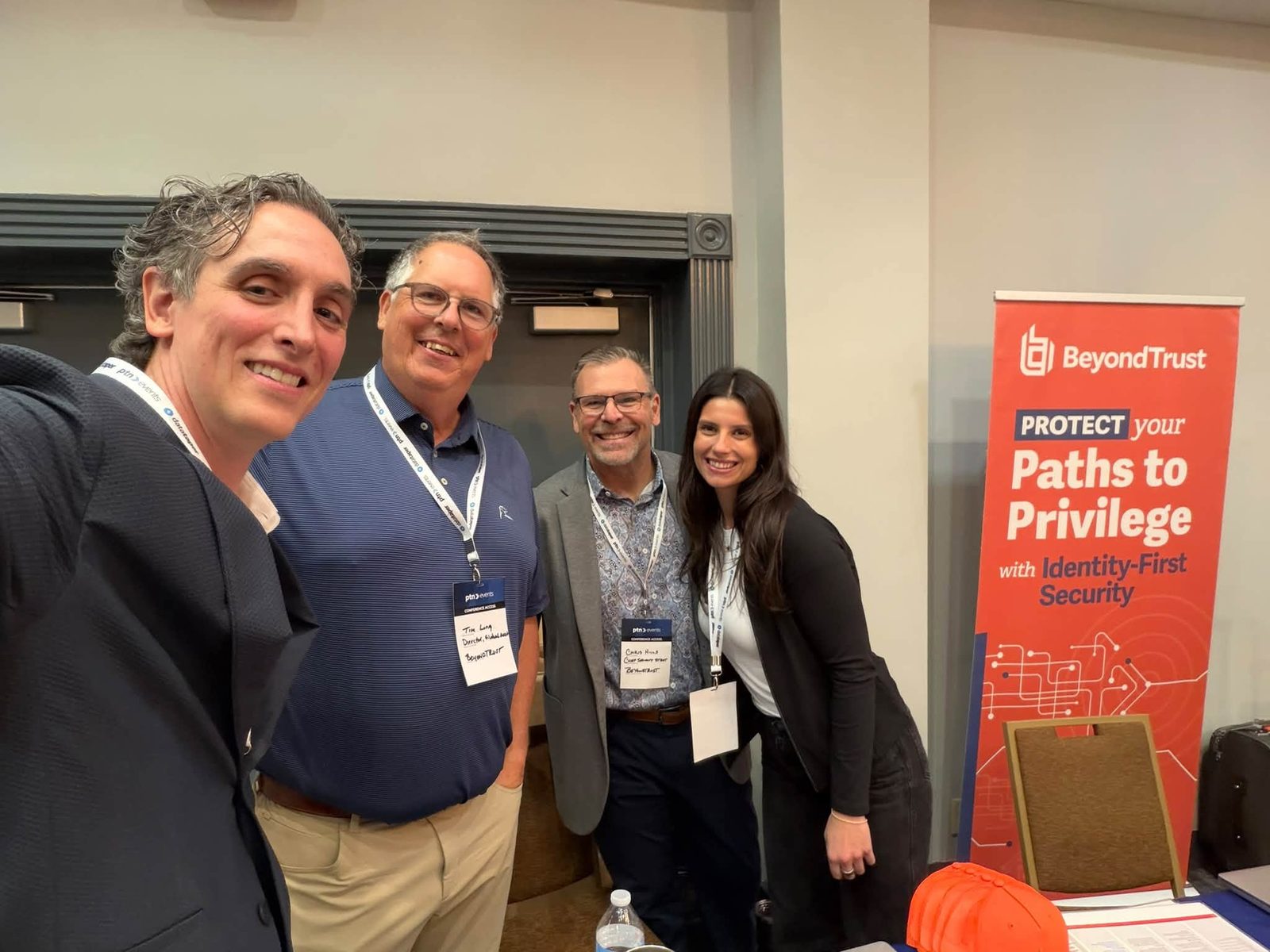
I got a picture with Hills and his colleague Tim Long at the BeyondTrust table, under a banner that put the whole idea in five words: protect your paths to privilege.
Friday morning, Daniel Bartucci of Owl Cyber Defense made the AI connection explicit. His agenda listing reads like three rules worth taping to a monitor: “AI’s appetite for data is widening the attack surface.” “Zero Trust in OT means minimizing inbound connectivity.” “Security enables transformation.”
The security point I brought home was about remote access to OT, the operational technology that actually runs the plant. It isn’t only about who can log in. It’s the path they take to get there and the permissions they carry once they’re in. And wherever you can, limit two-way communication. If data only needs to leave the plant for the analytics side, let it flow one way. That’s the job of a data diode, which NIST’s glossary defines as “a network appliance or device that allows data to travel only in one direction.”
Put Hills and Bartucci side by side and a practical point falls out. An AI agent that can open a work order or approve a ticket is one more login with privileges. Somebody has to decide which of those logins should exist and who answers for each one. That’s what AI decision governance is for, and it’s the work we do at ModalPoint. Pratik Mahajan, a senior data analyst at JP Morgan, closed out the conference on the same note at 4:00, with explainability, lineage and validation across AI-driven decisions and human oversight built into the workflow.
That gets at the distinction I kept coming back to after the conference: reporting versus control. An AI that reports tells a person what it sees, and the person decides. An AI in control acts on its own, and that means write access, a login with privileges and someone who answers for what it does. One session laid out five questions for drawing that line, with a simple rule attached: if you can’t answer them, human in the loop is the right call. I like that because it turns “should a person sign off on this?” from a gut call into a checklist.
What does it look like when it works?
The cleanest example on the program was Thursday morning, from Merina Leong, product manager for automations at Ironsight. Her description opens with three short sentences: “SCADA tells you the tank is filling. It doesn’t dispatch the truck, verify the load, or approve the ticket. That gap is where the cost sits.” That’s reporting versus control in three sentences.
Ironsight’s approach creates and dispatches the job from the SCADA reading, checks the load against GPS and metered volumes, and pushes the approved ticket into accounting. The company says it saves more than 15% on hauling costs, and the talk promised lessons from multiple field deployments. That’s Ironsight’s own figure. There’s no digital twin in it and no chatbot with a personality. It’s plumbing between a sensor and an invoice, and I mean that as a compliment, because that’s where a lot of real money sits.
Thursday afternoon, Miras Muratov of ScaleApp described AI engineering tools that, by the company’s account, cut early-stage process design from weeks to minutes and plug into the tools engineers already use, like Aspen and DWSIM. And Friday opened on heavy iron. Robert Macaulay of Baker Hughes made the case for moving from reactive maintenance to predictive, risk-based asset performance management. Marc Berger of Everllence followed with digital twins for compressors and turbines, including virtual commissioning and AI-powered virtual sensors to cut commissioning time.
The 2:00 panel on Friday, Investing in Digitalization, brought Senterfit back alongside Darren Shelton of Moran Shipping Agencies, Amol Bhatnagar of Capgemini, Rajesh Yadav of ValueMomentum, Steven Stein of CGI and Arnold “Marty” Martin, a senior manager for automation and power systems at Audubon. That’s a wide bench, and the topic called for one.
The question I left OGAD with was the baseline one. When y’all put an AI workflow in the field, did anybody write down the before number? Did it hold up after go-live? Tell me on LinkedIn.
Matthew Bertram is Chief Marketing Officer of the Oil & Gas Global Network, President of ModalPoint, an AI decision-governance advisory, and CEO of EWR Digital, a Houston digital marketing agency in business for more than 25 years. He hosts The Best SEO Podcast, created the LLM Visibility™ methodology for getting brands cited in AI search, and is a contributor to NIST’s Cyber-AI Profile.