
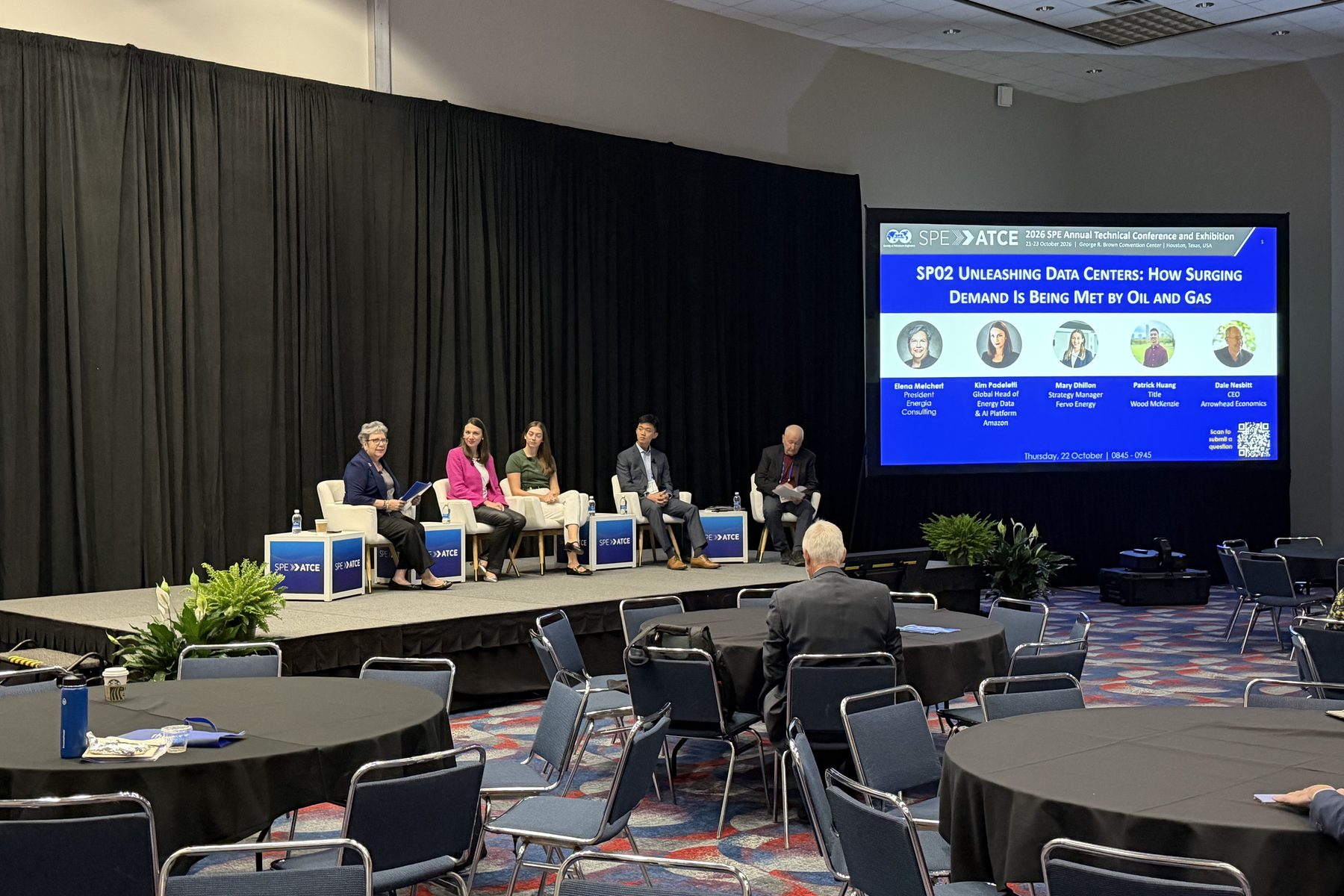
Most people go to SPE’s Annual Technical Conference and Exhibition for the reservoir papers, the drilling sessions and the folks you only see once a year. This year the first panel I sat in on was about data centers, and one of the five people on stage was Amazon’s global head of energy data and AI platform.
I was at the George R. Brown Convention Center on Thursday, October 22, on an OGGN press pass. SPE’s own numbers, published in JPT after the show, came to nearly 4,500 attendees from 57 countries, more than 150 exhibitors and over 300 technical papers, with more than 15 strategic and special sessions on the program. You don’t see all of that in one day. I didn’t try.
8:45 a.m., Room 372: the customer took the stage
The panel was Unleashing Data Centers: How Surging Demand Is Being Met by Oil and Gas, one of SPE’s 2026 strategic panels. Elena Melchert, president of Energia Consulting, was up there with Kim Padeletti of Amazon, Mary Dhillon of Fervo Energy, Patrick Huang of Wood Mackenzie and Dale Nesbitt, CEO of Arrowhead Economics. I got a picture of the screen with all five names on it.
The description doesn’t bury the lead. Hyperscale AI training clusters, it says, now need power loads comparable to small cities, and in a lot of regions that demand is outpacing grid expansion. Then comes the line I liked best. Data centers are no longer passive electricity consumers. They’re co-locating generation, signing long-term power agreements, financing new infrastructure and, in some cases, exploring dedicated energy assets of their own.
Look, that’s a customer conversation, and it’s a good one for this industry to be having in its own building. Most of the AI talk I hear at oil and gas events is about software coming in to make operators more efficient. This ran the other way. The biggest buyers of compute need power, a lot of it, faster than the grid can always deliver, and the people in Room 372 know how to deliver energy at scale.
Scott Tinker made the same case from the supply side in his keynote that week. As JPT reported it, he argued that secure energy takes both electricity and energy-dense molecules, with oil and natural gas staying essential because so much of industry and transportation runs on fuels beyond electricity alone.
10:30 a.m., Special Session Room 1: the ROI hour
This was the one I’d circled. Unlocking ROI of AI in Energy had Anthony Goodrow of ExxonMobil Upstream Research Co.; Alexander Lach, AI development manager at Occidental; Sonali Singh, a senior vice president at Quorum; and Raghu Yabaluri, managing director of natural resources at Black & Veatch. Late in the hour, when I took the picture below, there were still people standing in the aisle.
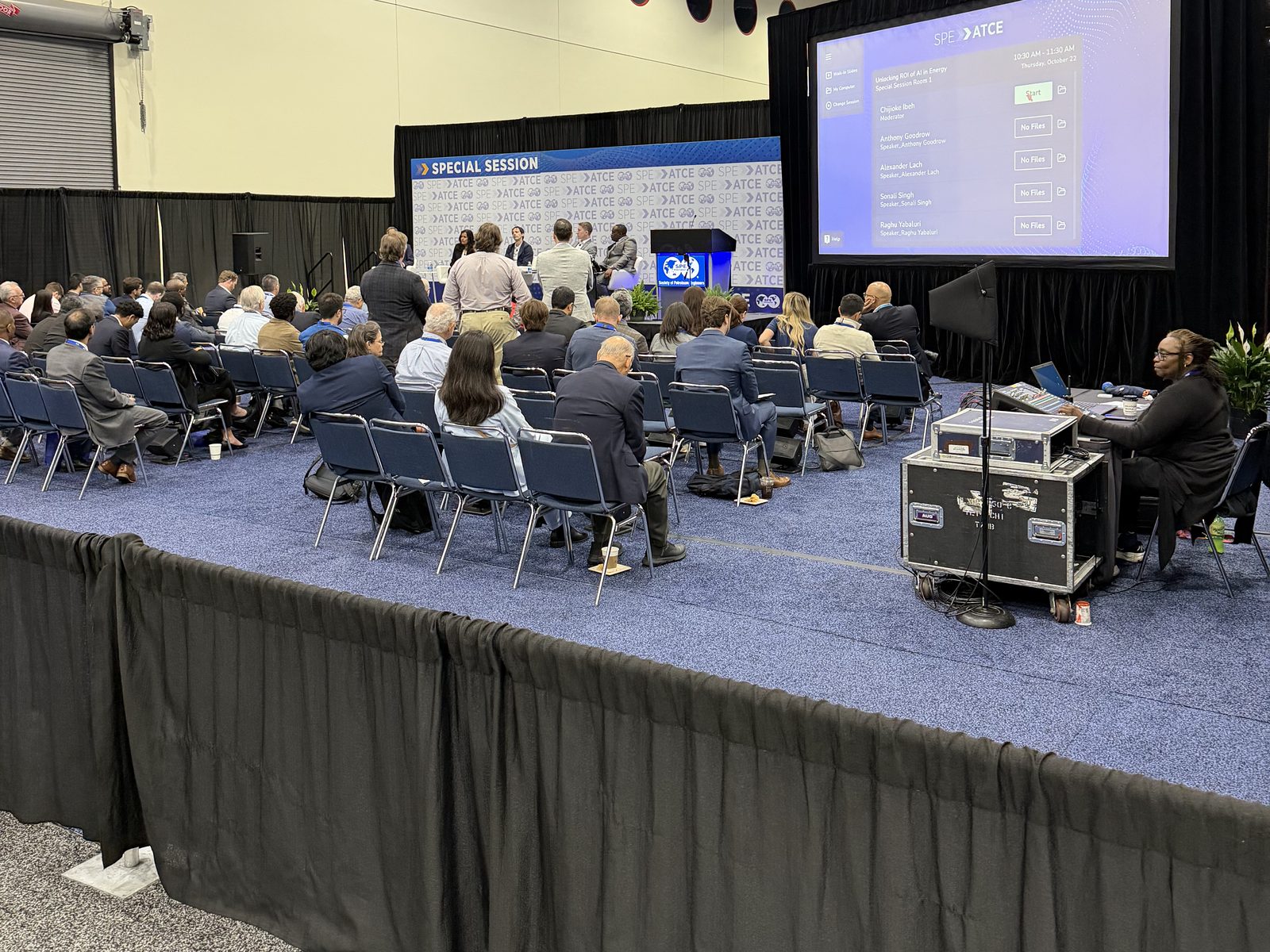
The session description is refreshingly direct about the problem. AI is demonstrating real benefits across the energy industry, it says, yet many organizations still struggle to get a real return across the core business. Then it steers the conversation away from algorithms and tools and toward metrics, execution models and engineering-leadership partnerships. The pillars it lays out are worth reading slowly:
- “Metrics That Matter,” meaning engineering and business KPIs that actually line up on productivity, cost and risk.
- Executives and engineers working together closely enough that strategy reflects what’s happening in the field.
- Breaking down silos, so ROI compounds across a portfolio instead of living inside one project.
- Trust, accountability and human-AI augmentation, which the description calls “critical ROI multipliers.”
- Getting “from isolated pilots to scalable, repeatable deployments.”
Honestly, that’s the right list. I wrote here in August about why so many AI projects stall right after the demo, and nearly every item on it is in that description. You don’t fix a pilot that won’t scale by buying a better model. You fix it by agreeing on what you’re measuring before you start, and by getting the people who run the asset and the people who sign the budget into the same room. And none of the ROI math works if the data underneath it isn’t clean.
The day before, the agentic AI panel on that same strategic program made the data point even more plainly. The Agentic Alliance put OpenAI, Anthropic, an AWS generative AI practice lead, a Texas A&M professor and Devon’s drilling engineering supervisor on one stage, with Josh Etkind of ThinkOnward moderating. Its description calls the industry’s decades of operational, subsurface and production data “one of the most valuable and underutilized assets in the global economy.” It also says that when billions of dollars and human lives depend on autonomous systems, “trust and auditability are not optional.” I wasn’t in that room on Wednesday, but I’d put that sentence on the wall of every AI steering committee in Houston.
1:37 p.m., the exhibit floor: two mics at the OGGN table
After lunch I was back down on the floor at the OGGN table. Two podcast mics, a recorder, headphones and a pair of cameras on tripods, with Minitab’s booth right behind us. That’s where a lot of ATCE happens. The sessions give you the frame, and the floor gives you the people, the ones who’ll tell you over a cup of coffee what’s working in their shop and what isn’t yet.
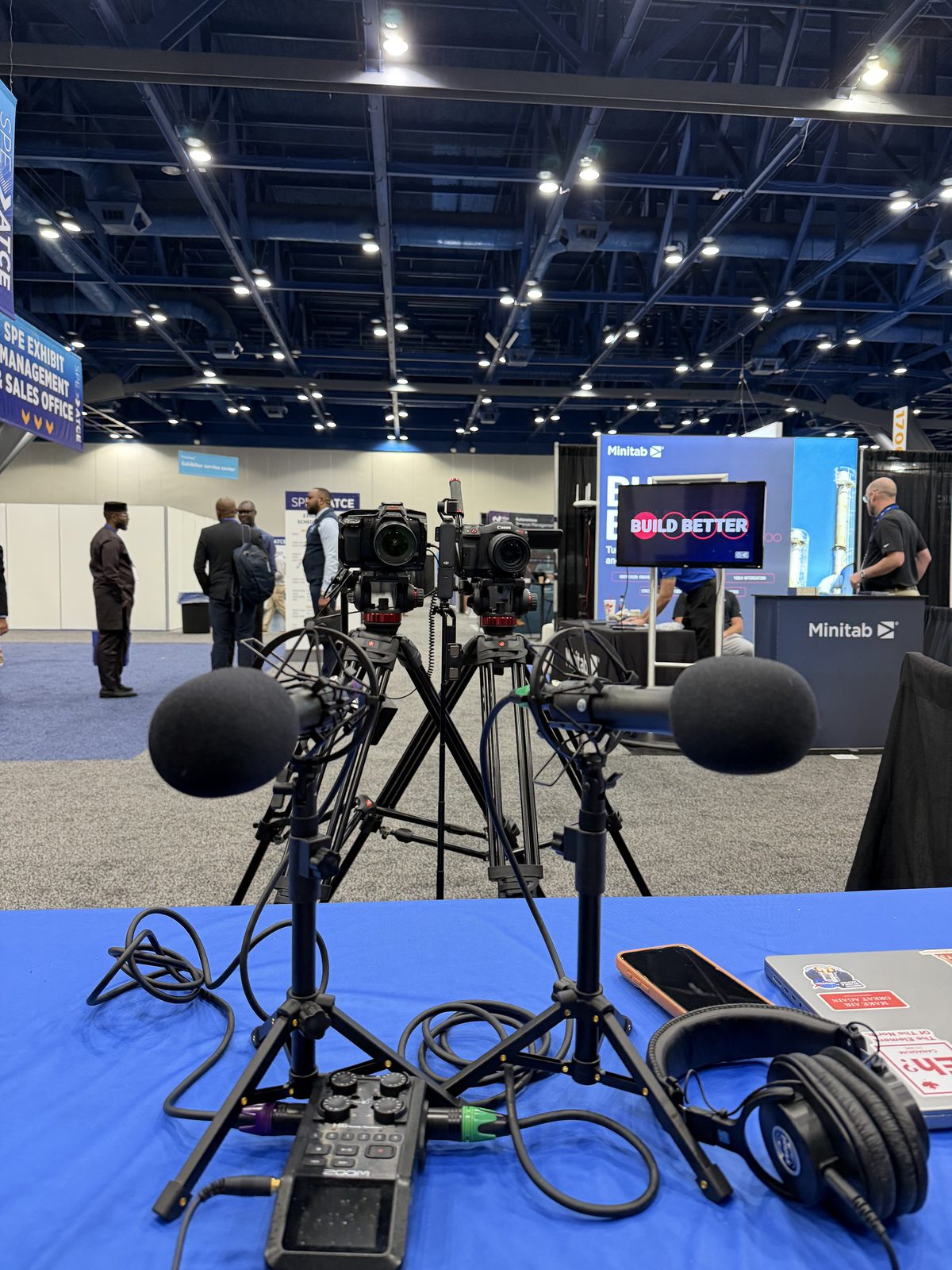
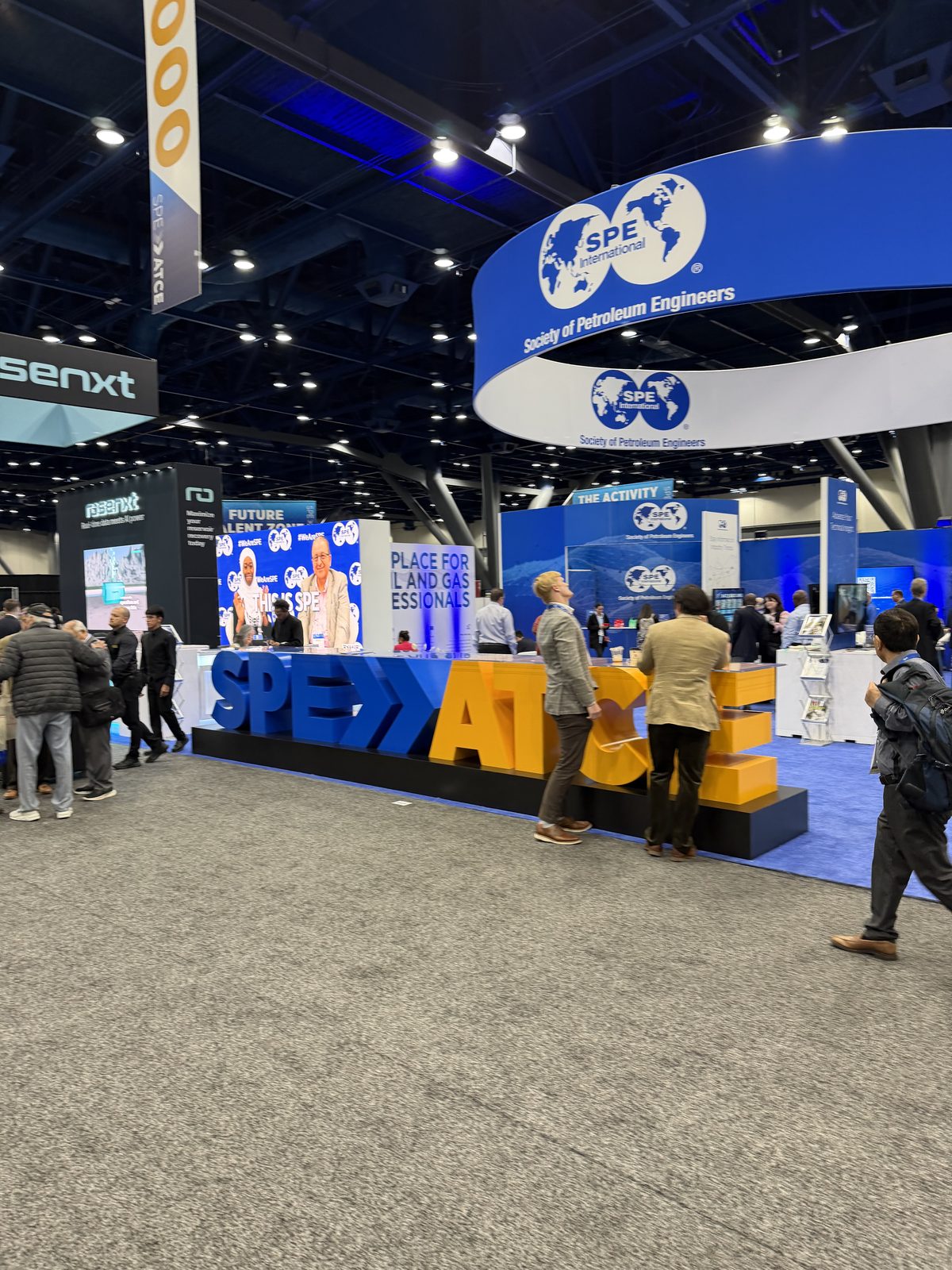
If you stopped by the table, thank you for the time. SPE’s own pavilion was out on the floor too, under the big ATCE sign.
2:00 p.m., back to Special Session Room 1: the boardroom
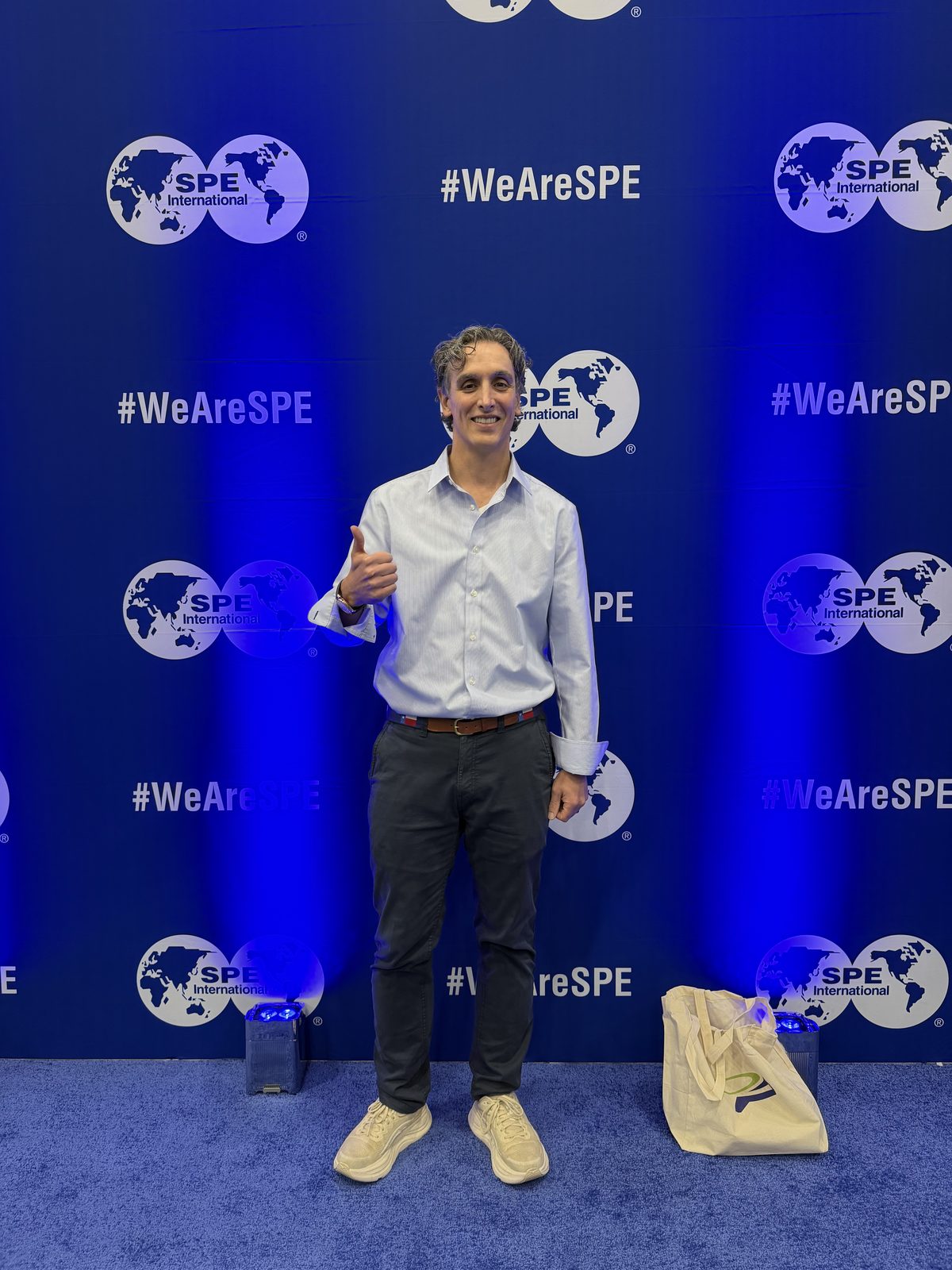
The afternoon AI session went up a level. From Operations to the Boardroom had Michael Edwards of Edwards Energy Innovation moderating Bo Hu, director of AI at ConocoPhillips; Jitendra Kikani, Chevron’s vice president of subsurface; Alexander Ray, director of production at Chord Energy; and Hani Elshahawi, director of innovation at BV. Full disclosure, I was getting my picture taken at the #WeAreSPE wall when it started, so this part comes from the published description and not my notes.
The description says the industry has traditionally pointed digital tools at optimizing operations and managing assets, and the trend now is to take that conversation into the boardroom. It names where that shows up: strategic and investment decisions, cost and spend visibility, risk management and governance, and leading the organizational change it takes to actually adopt AI-driven insights.
That’s the conversation I most want to see more of. I’ve argued here that AI governance is a board mandate, not an IT project, and it was good to see SPE give operators like ConocoPhillips and Chevron a stage for exactly that shift. Once AI starts informing where capital goes, somebody at the top has to own how those recommendations get made and how they get checked.
Where to find these on the program
If you missed any of these and want to pull up the descriptions or track down the speakers, here’s where they sat.
| When | Session | Room | On stage |
|---|---|---|---|
| Wed., Oct. 21, 3:45 p.m. | The Agentic Alliance (strategic panel) | Room 372 BCEF | OpenAI, Devon, AWS, Texas A&M, Anthropic; ThinkOnward moderating |
| Thu., Oct. 22, 8:45 a.m. | Unleashing Data Centers (strategic panel) | Room 372 BCEF | Energia Consulting, Amazon, Fervo Energy, Wood Mackenzie, Arrowhead Economics |
| Thu., Oct. 22, 10:30 a.m. | Unlocking ROI of AI in Energy | Special Session Room 1 | ExxonMobil Upstream Research, Occidental, Quorum, Black & Veatch |
| Thu., Oct. 22, 2:00 p.m. | From Operations to the Boardroom | Special Session Room 1 | ConocoPhillips, Chevron, Chord Energy, BV; Edwards Energy Innovation moderating |
Next October, Denver
At the President’s Luncheon on Friday, as JPT reported it, incoming SPE President C. Susan Howes picked four words she said reflect what SPE does best: “Learn. Share. Connect. Grow.” ATCE 2027 is October 11 to 13 at the Colorado Convention Center in Denver.
If you sat in Special Session Room 1 on Thursday and wrote down a number one of the panelists shared, or you’re running an AI workflow that’s been live long enough to show a return, send me a note on LinkedIn. I want to hear how y’all are measuring it.
Matthew Bertram is Chief Marketing Officer of the Oil & Gas Global Network, President of ModalPoint, an AI decision-governance advisory, and CEO of EWR Digital, a Houston digital marketing agency in business for more than 25 years. He hosts The Best SEO Podcast, created the LLM Visibility™ methodology for getting brands cited in AI search, and is a contributor to NIST’s Cyber-AI Profile.