
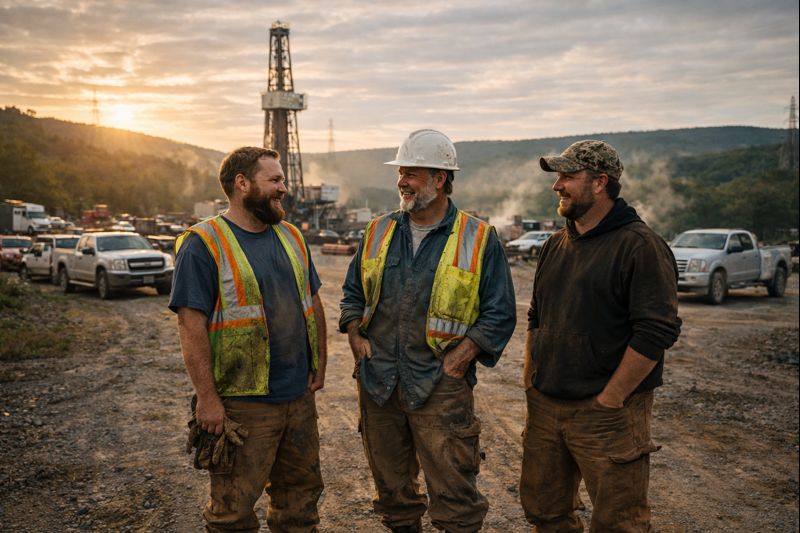
The gas business came to town wearing a uniform we didn’t recognize.
Pants tucked into boots. Shirts cut different. Trucks set up different. They didn’t look like the boys we grew up with. They ordered strange foods and spoke differently. You could spot them across a parking lot without trying. That was the early picture — the “gas guy” as outsider. Temporary. Passing through on his way to somewhere louder.
We were told they’d move here. Some did.
Most didn’t.
What happened instead was quieter and more interesting. The locals went to work.
That part still seems to confuse critics of the industry. They talk about “gas workers” like they’re a separate species. Imported. Numbered. Anonymous. But in rural places like Tioga County, the label breaks down fast. Because the gas worker usually turns out to be somebody you already know.
And memory refuses to use job titles.
I graduated in ’97. Sixty-five in the class. Seventy if you count the foreign exchange kids. Two Thirds of us still around in one form or another. Some already retired. Time moves quicker than the guidance counselor promised. Hell- My Youngest just joined the US Navy. I’m a grandfather- ok I’ll stop.
Off the top of my head, about ten from that class work in energy. Two more receive royalty checks big enough to matter. I’m Including Myself in these employment stats — a working word mechanic who wouldn’t be writing about energy at all if shale hadn’t taken off and the ’08 crash hadn’t knocked the furniture over.
Loose math says that’s close to one in three (classmates) tied directly to the energy world from one small rural graduating class. Not a formal survey. Just lived knowledge and reunion talk.
Then widen the circle.
How many are married to someone in the industry? How many have a son or daughter in it? How many travel out of state for projects — Texas, New Mexico, the Gulf — and bring the income back home? The address stays local even when the job site doesn’t.
Some public data suggests that in rural energy counties, as many as one in five working-age people are either in the industry or closely tied to it. That’s not hype. That’s the ripple effect — trades, utilities, fabrication, trucking, land services, supply houses, inspection, maintenance.
But I still don’t see “energy workforce.”
I see Brad — we called him “Food”, and the reason is too long and too stupid to print. Joel — decades in the industry now — but I remember the golf ball he launched across the sports field that caught our gym teacher square on the head with impossible accuracy. He said he still remembers that day vividly. Russ and his long hair and Jim Morrison like singing voice. A guy named Preston A killer drummer— born able to fix anything with moving parts — nicknamed Prestone before any of us knew what viscosity meant.
We also turned out a fighter pilot. A specialist dentist. An insurance brain with an ironed shirt life. Some people were always headed white collar and altitude. Fair enough. If you can fix a jaw or fly combat, you’re probably not going to stand on frozen iron at 5 a.m.
But a lot of the rest built their living in and around energy.
The outsiders showed up first. That part is true. Different look. Different habits. Different road dust on the truck.
Then the neighbors put the boots on.
Now when someone says “gas guy,” half the time they’re talking about somebody whose sister was in your class, whose dad coached Little League, whose nickname still makes no sense twenty-five years later.
That’s not invasion.
That’s absorption.
And it’s done more for a lot of rural towns than the headlines like to admit.