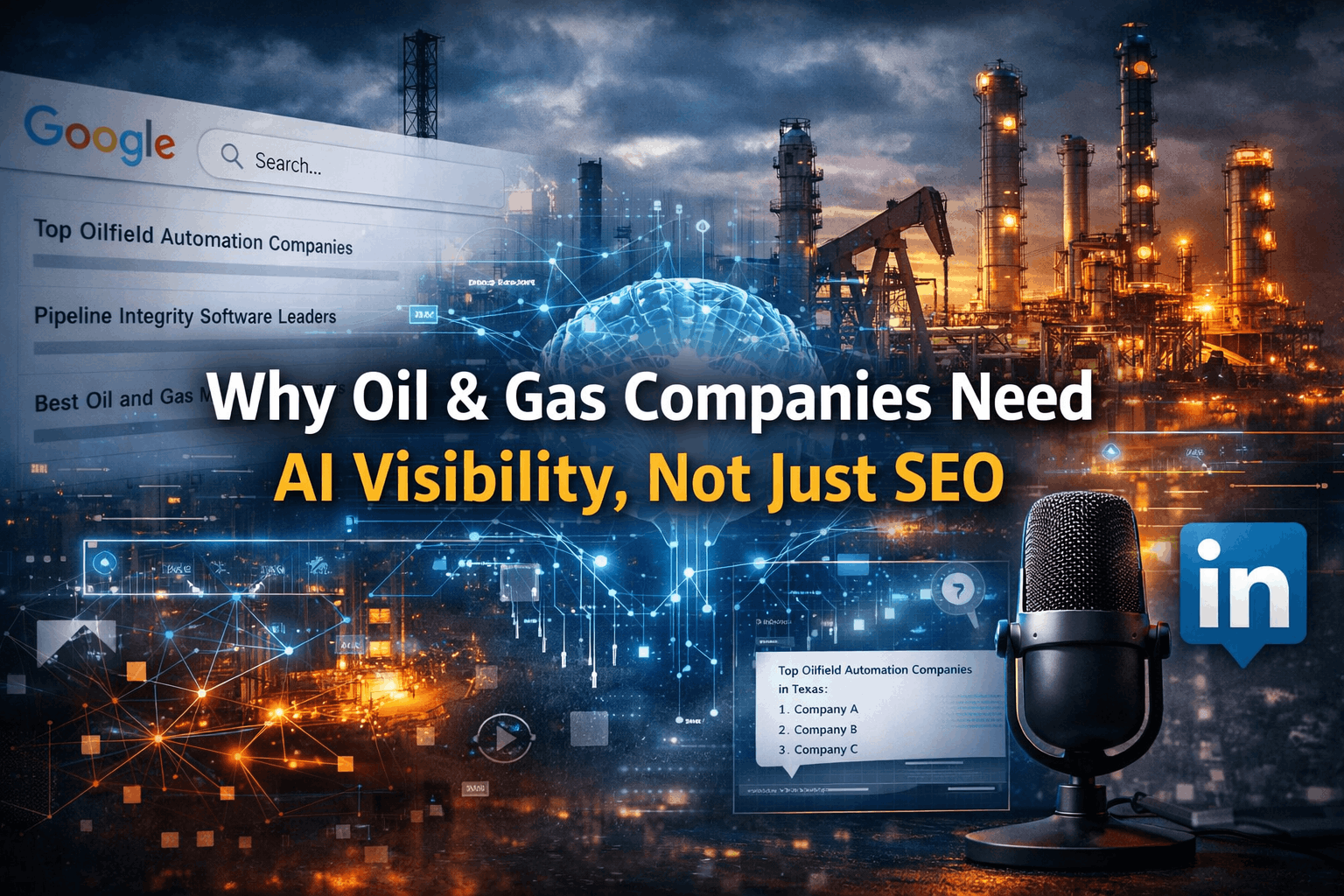
For years, most oil and gas companies thought digital visibility meant one thing: ranking in Google.
That is still important.
But the market is changing.
Today, buyers, investors, recruits, journalists, and even potential partners often learn about a company long before they ever talk to someone directly. They are finding businesses through Google searches, AI-generated answers, LinkedIn posts, podcasts, YouTube videos, industry articles, and digital word of mouth.
In many cases, those systems become the first impression.
That means companies are no longer competing only on reputation, relationships, and operational performance. They are also competing on how they are interpreted across search engines, AI systems, industry media, and digital channels.
That is why oil and gas companies need more than SEO.
They need AI visibility.
SEO Still Matters — But It Is No Longer Enough
Traditional SEO is still important because it helps companies rank for the products, services, and markets they want to be found for.
But search behavior is changing quickly.
More people are using AI systems to summarize vendors, compare companies, answer technical questions, and surface “best fit” providers without clicking through ten different websites.
Instead of searching for “oilfield automation company Houston,” someone might ask:
- Who are the top oilfield automation companies in Texas?
- Which companies are leaders in pipeline integrity software?
- What marketing agencies specialize in oil and gas?
- Who understands both AI and the energy sector?
AI systems increasingly answer those questions directly.
That changes the game.
If your company only focuses on ranking for a few keywords, but AI systems do not understand who you are, what you do, or why you matter, then you may become less visible over time — even if your website still ranks reasonably well.
AI Visibility Is About How Your Company Gets Understood
AI visibility is not just about traffic.
It is about whether search engines, AI systems, and digital platforms correctly understand:
- What your company does
- What industries you serve
- What products or services you provide
- What problems you solve
- Why your company is different
- Whether you are trusted by the market
That information does not come from a single page on your website.
It comes from the broader digital ecosystem.
AI systems learn from far more than your website. They learn from industry media mentions, podcast appearances, press releases, LinkedIn activity, reviews, structured data, author profiles, directories, backlinks, and third-party citations.
That is one reason companies like ModalPoint matter. They help businesses better understand oil and gas buyer behavior, commercialization strategy, and how the industry actually makes decisions.
In other words, your company is increasingly being defined by the total digital footprint around it.otprint around it.
Why This Matters for Oil & Gas Companies
Oil and gas is a relationship-driven industry.
More oil and gas companies are investing in digital transformation, AI, and customer-centric strategies as the industry evolves.
But it is also an industry where trust matters, risk matters, and buying cycles are long.
Before someone takes a meeting, requests a proposal, or responds to outreach, they often research the company first.
If the company has weak digital visibility, outdated positioning, or little presence outside its own website, that creates friction.
On the other hand, when a company appears consistently across search results, podcasts, industry publications, LinkedIn, and AI-generated answers, it builds trust faster.
That is especially important for:
- Service companies trying to stand out in crowded markets
- Industrial manufacturers with highly technical offerings
- Technology companies entering the energy sector
- Engineering firms and contractors
- Companies expanding into new regions or service lines
- Firms trying to recruit top talent
The companies that will win in the future are not always the companies with the biggest budgets.
They are often the companies that become easiest to understand, easiest to trust, and easiest to find.
Why Podcasts and Content Matter More Than Ever
One of the biggest shifts happening right now is that AI systems are increasingly learning from content that exists outside of your website.
That includes:
- Podcast interviews
- Industry articles
- Guest appearances
- YouTube videos
- LinkedIn posts
- Webinars
- Conference speaking engagements
- Press releases
- Case studies and thought leadership
High-quality content does more than generate awareness.
It creates digital proof that your company exists, what it stands for, what problems it solves, and where it has authority.
Companies that participate in trusted industry media environments like OGGN can build authority much faster than companies that rely only on their website.
Podcasts are especially powerful because they combine credibility, relationships, search value, and long-form conversations that AI systems can interpret.
A strong podcast appearance can turn into:
- A show page
- A transcript
- Social clips
- Quotes
- Backlinks
- Mentions on other websites
- YouTube videos
- AI-readable content across multiple platforms
That means a single podcast appearance can create dozens of digital signals that reinforce your expertise.
For oil and gas companies, this matters because buyers increasingly trust companies they repeatedly see across multiple channels.
The companies that consistently create useful content, participate in industry conversations, and show up in trusted media environments will have an advantage over those that remain invisible.
Oil and gas is a relationship-driven industry.
But it is also an industry where trust matters, risk matters, and buying cycles are long.
Before someone takes a meeting, requests a proposal, or responds to outreach, they often research the company first.
If the company has weak digital visibility, outdated positioning, or little presence outside its own website, that creates friction.
On the other hand, when a company appears consistently across search results, podcasts, industry publications, LinkedIn, and AI-generated answers, it builds trust faster.
That is especially important for:
- Service companies trying to stand out in crowded markets
- Industrial manufacturers with highly technical offerings
- Technology companies entering the energy sector
- Engineering firms and contractors
- Companies expanding into new regions or service lines
- Firms trying to recruit top talent
The companies that will win in the future are not always the companies with the biggest budgets.
They are often the companies that become easiest to understand, easiest to trust, and easiest to find.
The Rise of Digital Information Governance®
As AI becomes more important, companies also need to think about how their information is managed across the market.
If different websites describe your company differently, if your messaging is inconsistent, if old information is still ranking, or if AI systems are pulling inaccurate summaries about your business, that can create real problems.
That is where Digital Information Governance® becomes important.
Digital Information Governance® is the process of managing how your company is represented across search engines, AI systems, websites, industry media, and digital channels.
It is not just about marketing.
It is about making sure the market understands your business correctly.
The Future of Oil & Gas Visibility
The energy sector is entering a new phase.
SEO still matters.
But search rankings alone are no longer enough.
The companies that win will be the ones that combine strong expertise with strong digital visibility, trusted industry positioning, and clear AI-readable signals.
In the future, buyers may discover your company through Google.
But they may also discover you through AI-generated answers, podcast interviews, LinkedIn posts, industry media, YouTube clips, and digital conversations happening long before they ever reach out.
That is why oil and gas companies need AI visibility, not just SEO.
Because the future of the industry will not just be shaped by energy markets.
It will also be shaped by how companies are discovered, interpreted, and trusted online.