
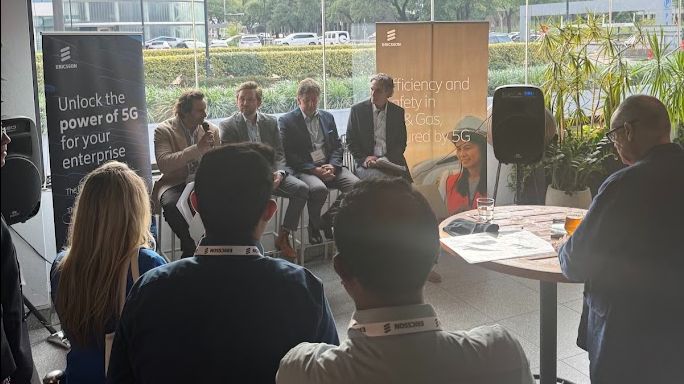
At OTC this week in Houston, one theme kept surfacing beneath all the AI discussion:
Most industrial AI projects still succeed or fail at the infrastructure layer.
I had the opportunity to moderate a conversation hosted by Ericsson Enterprise Wireless Solutions around private wireless networks, offshore operations, and AI deployment in industrial environments. The panel brought together perspectives from Bechtel, Rockwell Automation, and leaders working directly in industrial connectivity and offshore operations such as RuggedEdge.
What stood out wasn’t the hype around AI.
It was how operational the conversation has become.
For years, AI in oil and gas mostly lived inside innovation teams, pilot programs, and conference presentations. The technology looked promising, but deployment at scale across offshore and industrial environments remained difficult. Connectivity limitations, fragmented systems, cybersecurity concerns, and inconsistent operational data kept many projects from moving beyond proof-of-concept stages.
That gap is starting to close.
And one of the biggest reasons is improvements in industrial connectivity infrastructure.
Connectivity Is Becoming Operational Infrastructure
One thing became very clear during the discussion:
Connectivity is no longer just an IT or communications function.
It is becoming core operational infrastructure.
The ceiling for what companies can realistically do with AI, automation, remote monitoring, and predictive systems increasingly depends on the reliability of the underlying network.
In offshore operations, that matters more than many people outside the industry realize.
These are not office environments where downtime creates inconvenience. Offshore and industrial operations involve safety-critical systems, distributed assets, hazardous environments, tight production schedules, and operational decisions that carry significant financial consequences.
If connectivity becomes unstable, operational visibility starts to break down.
When telemetry is delayed, incomplete, or inconsistent, operators stop trusting the system regardless of how advanced the AI model may be.
And once trust disappears, deployment slows down quickly.
That operational reality is shaping how industrial companies approach AI adoption.
The Industry Is Moving Beyond Experimentation
Another noticeable shift was the maturity of the conversation itself.
A few years ago, most discussions centered around possibility:
“What could AI eventually do?”
Now the conversation sounds more practical:
“How do we deploy this safely, reliably, and in a way operations teams will actually use?”
Operators are becoming far more selective.
The focus is shifting toward systems that:
- improve visibility across operations
- reduce downtime
- support maintenance and inspection workflows
- improve response times
- increase worker safety
- help experienced teams make faster decisions
- integrate into existing infrastructure without creating additional operational risk
That shift matters.
Industrial companies are not looking for novelty. They are looking for systems that can survive real operating conditions and deliver measurable operational value.
That includes offshore environments where bandwidth constraints, intermittent connectivity, environmental conditions, and aging infrastructure create challenges many AI vendors are not used to dealing with.
Real-Time Data Is Still the Bottleneck
One of the strongest themes from the panel was that the limiting factor for industrial AI often is not the model itself.
It is the quality and reliability of the operational data environment surrounding it.
Industrial environments generate enormous amounts of data from:
- field sensors
- SCADA systems
- inspection workflows
- production telemetry
- maintenance systems
- environmental monitoring
- compressors and rotating equipment
- offshore instrumentation and control systems
But much of that data still lives across disconnected systems or legacy infrastructure.
In many environments, operational teams still deal with:
- delayed telemetry
- incomplete field visibility
- fragmented reporting
- manual data reconciliation
- alarm overload
- inconsistent data quality across assets
Without trusted real-time data, AI systems struggle to produce outputs operators can confidently act on.
And in industrial operations, hesitation usually means the system never reaches production deployment.
Private wireless infrastructure does not solve every challenge.
But it helps reduce latency, improve reliability, and support more consistent operational visibility across distributed environments.
That creates better conditions for industrial AI systems to function reliably at scale.
Offshore Environments Raise the Stakes
Offshore operations amplify every infrastructure challenge.
Maintenance is harder.
Connectivity is harder.
Redundancy matters more.
Downtime becomes significantly more expensive.
Cybersecurity concerns increase.
Remote visibility becomes critical.
What works in a controlled office environment often does not translate directly into offshore operations.
That is one reason private wireless networks, edge processing, and industrial 5G infrastructure are receiving increased attention across energy and heavy industry.
The goal is not simply faster connectivity.
The goal is resilient operations.
Reliable infrastructure supports:
- remote asset monitoring
- predictive maintenance
- digital inspections
- reduced exposure for field personnel
- faster operational response times
- better coordination between offshore and onshore teams
- more consistent visibility across distributed assets
The technology stack becomes interconnected very quickly.
AI depends on operational data.
Operational data depends on connectivity.
Connectivity depends on resilient infrastructure designed for industrial conditions.
A More Grounded Approach to AI
What may be changing most is the mindset around deployment.
The industry still remains appropriately cautious.
Operators are not blindly handing over critical decisions to AI systems, nor should they.
But the conversation is becoming more grounded in operational realities instead of theoretical transformation narratives.
The focus is shifting toward:
- reliability
- governance
- cybersecurity
- operational resilience
- integration with existing systems
- deployment discipline
- infrastructure readiness
That is probably a healthy evolution.
Because in industrial operations, the companies that win are rarely the ones that move the fastest without discipline.
They are the ones that can deploy technology safely, repeatedly, and reliably under real operating conditions.
Final Thought
One thing became clear throughout the discussion at OTC:
Industrial AI adoption will not be determined solely by the sophistication of the models.
It will be determined by whether organizations can build the infrastructure, operational visibility, and trusted data environments required to support real-time decision-making at scale.
And increasingly, that starts with connectivity.
Matthew Bertram is Chief Marketing Officer of OGGN, President of ModalPoint, and CEO of EWR Digital.