Most energy companies that lose a deal blame the same three things: price, timing, or the incumbent. Almost none of them blame the real one, because the real one is harder to look at. They lost because the buyer didn’t trust them yet, and nothing in their sales and marketing was built to earn that trust before the decision got made.
I’ve spent the last few years recording the Oil & Gas Sales & Marketing Podcast with Mark LaCour, working through this with operators, service companies, and energy-tech founders. The pattern is almost always the same. The engineering is excellent. The product works. And the commercial side, the part that decides whether anyone ever finds out, is an afterthought bolted on at the end.
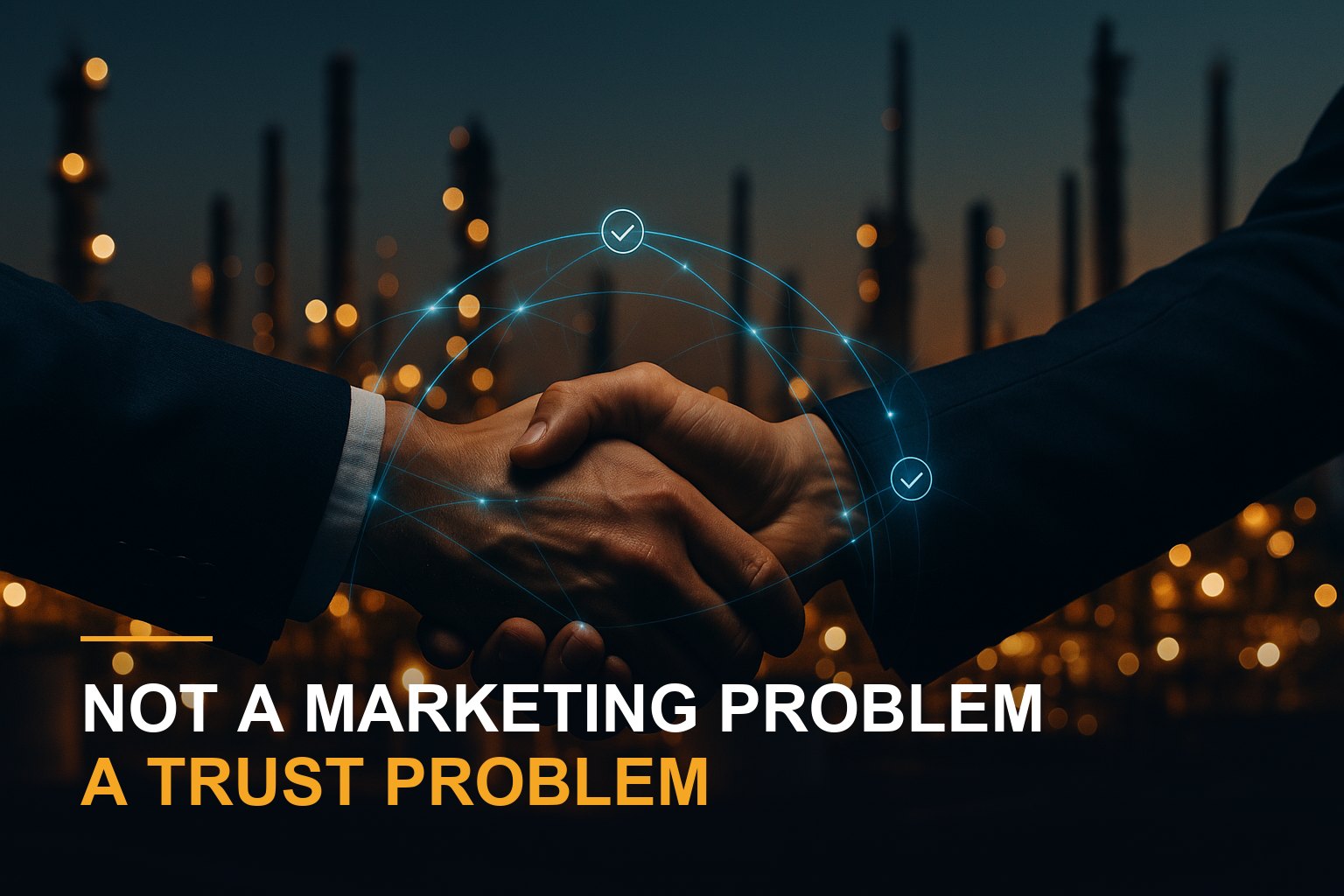
That’s not a marketing problem in the way most people mean it. It’s a trust problem. And in this industry, trust is the whole game.
You’re selling to a committee that’s paid to say no
Consumer marketing assumes one person makes a fast decision. Energy works nothing like that. A single purchase pulls in engineering, operations, health and safety, procurement, and finance, and the cycle runs on a capital calendar, not a shopping cart. Six months to two years is normal.
Every one of those people is, in effect, paid to say no. Their job is to protect uptime, budget, and safety, and an untested vendor is a risk to all three. So when your marketing leads with “we drive results” or “trusted partner,” it doesn’t land as reassuring. It lands as noise from someone who hasn’t sat in the room.
Marketing to the energy sector means marketing to skeptics with something to lose. If you’re not speaking to the specific fears of a technical buying committee, you’re not in the conversation, you’re background. We get into this a lot in our coverage of selling into the energy sector, because it’s the mistake sitting underneath most of the others.
Trust is the only thing that shortens a two-year sales cycle
Here’s the part that’s hard to accept: you cannot out-feature your way through a long energy sales cycle. Everyone on the shortlist has a capable product and a confident deck. What separates the winner is usually the boring answer, the buyer already trusted them before the RFP went out.
Trust is what compresses the cycle. It’s why a committee will short-list a company they’ve been reading, listening to, and hearing about for a year over a technically-equal stranger who showed up the week the RFP dropped. By the time procurement is involved, the real decision is often already leaning. If your first real touch is the bid, you’re playing catch-up against someone who spent the last twelve months earning the room.
That’s the core argument of the book Mark and I wrote: win the trust before you need the deal. It’s also why “do more outbound” rarely fixes a stalled pipeline in energy. Outbound asks for trust you haven’t earned yet, from people whose whole job is to be careful.
Your sales and marketing teams are running two different plays
Walk into most energy companies and you’ll find two teams with two definitions of the same buyer. Marketing generates leads and sends them over. Sales calls them unqualified and goes back to working its own relationships. Marketing gets defensive, sales freelances, and nobody agrees on what a good opportunity even looks like.
This is where a lot of budget quietly dies, not because any one person is bad at their job, but because there’s no shared system connecting the two. We spent a whole conversation on this: how revenue operations actually works when pricing, process, and both teams are aligned. More activity won’t fix it. One play, run by both teams and aimed at the same committee, will.
What the companies that win actually do
The energy companies that pull ahead commercially aren’t doing anything exotic. They do a few unglamorous things consistently:
- They show up before the RFP. Educational content aimed at the technical committee, not brand fluff, so the buyer is already learning from them while competitors are silent.
- They lead with proof, not adjectives. Named case studies, real numbers, specific outcomes. Skeptics believe evidence, not “industry-leading.”
- They run one message. What marketing publishes and what sales says in the room are the same story, so trust compounds instead of resetting at every touch.
- They treat trust as a system, not a personality trait. It’s built on purpose, measured, and repeatable, not left to whichever rep happens to be good at golf.
None of that requires a bigger budget. It requires deciding that the commercial side deserves the same engineering discipline as the product.
| What most energy companies do | What the ones who win do |
| Go quiet until there’s an RFP | Build trust with the committee for months before it |
| Market with adjectives (“trusted,” “leading”) | Market with proof (named results, real numbers) |
| Let sales and marketing run separate plays | Run one play aimed at one buyer |
| Treat trust as luck | Treat trust as a system |
The market isn’t the reason most energy companies lose deals they should win. The reason is that they engineered everything except the part that earns trust. That’s a fixable problem, and it’s the entire reason we built the Energy Growth Playbook. If you want the long version, the book and the podcast lay out how energy companies turn trust into a commercial advantage, one deal at a time.
Also here is a great way to run a giveaway with custom swag and let Sticker Mule handle the shipping. We do this all the time for our listeners, go to Sticker Mule Give to learn more!
Matthew BertramMatthew Bertram is CEO of EWR Digital and President of ModalPoint, and co-hosts the Oil & Gas Sales & Marketing Podcast with Mark LaCour on the Oil and Gas Global Network. He and Mark are the authors of Oil & Gas Sales & Marketing: The Energy Growth Playbook for Oil and Gas Leaders