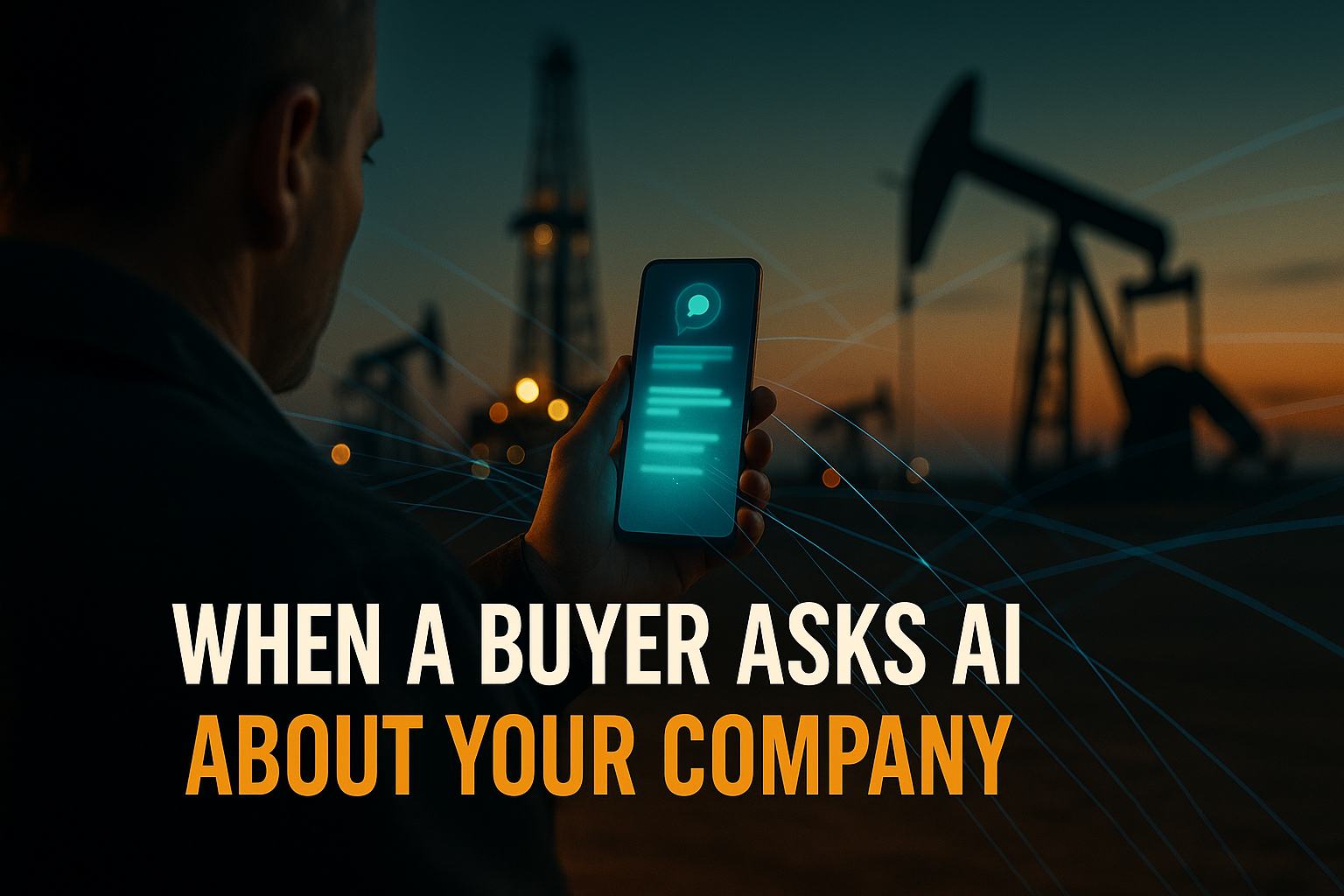
A procurement lead at an operator has a short list to build. Ten years ago she’d have called three people she trusts and run a Google search. Today, before any of that, she opens ChatGPT and types: “Who are the most reliable oilfield service companies for [this scope] in [this basin]?” Whatever the machine says back becomes her starting shortlist, and if your company isn’t in the answer, or shows up thin and dated next to two competitors, you’ve lost the bid before a human at your firm ever knew it existed.
That is the uncomfortable new reality for oilfield service companies: a growing share of your buyers now form their first impression of you from an AI’s summary, not your website, not a referral, and not your sales team. The AI’s description of your company is your company, as far as that first cut is concerned. Most service firms have never once checked what that description says. This is a walk-through of how to find out, why the answer is usually worse than you’d expect, and what actually moves it.
What Does an AI Actually Say When a Buyer Asks About Your Company?
Start with the test, because most executives have never run it. Open ChatGPT, Perplexity, and Google’s AI answer box and ask the questions a real buyer would ask: “Is [your company] a credible provider of [your core service]?” “Who are the top [your service] companies working in [your basin]?” “Compare [your company] to [a known competitor].” Read each answer as a skeptical procurement lead, not as the person who signs the payroll.
You’ll usually see one of three failures. The AI omits you entirely and names competitors instead. It describes you accurately but blandly, with none of the differentiators you actually win on. Or it gets you plainly wrong: wrong service lines, wrong footprint, a merger that happened confused with one that didn’t. Each of those is a lost opportunity that never shows up in your CRM, because the buyer who was quietly steered elsewhere never contacts you to say so. In a business where a single frame agreement or service contract runs into the millions, an AI that leaves you off the shortlist is not a marketing nuisance. It is silent revenue leakage.
Why the AI Leaves You Out, or Gets You Wrong
AI answer engines don’t have opinions about your company. They assemble an answer from the sources they can find and read clearly, and they lean on the ones that are consistent, structured, and corroborated in more than one place. Oilfield service companies tend to fail that test for reasons that have nothing to do with the quality of their work:
The website describes the business in insider language a model can’t map to a buyer’s plain-English question. The company’s name, locations, and service lines are written three different ways across the site, LinkedIn, industry directories, and old press, so the machine can’t decide which version is true. There’s almost no third-party presence on the credible, well-structured sources these systems actually pull from. And the pages that do exist bury the answer to a buyer’s question inside a wall of undifferentiated prose, where nothing is cleanly extractable. The model isn’t punishing you. It simply can’t confidently say something about a company it can’t confidently read.
Isn’t This Just SEO With a New Name?
It rhymes with SEO, but the target moved. Classic search optimization was built to earn a click: get the blue link ranked so a human comes to your site. Answer engine optimization is built to earn a citation: get your company described accurately, and named, inside an answer the buyer reads without ever clicking through. The buyer’s journey now often ends at the AI’s summary. That changes what you optimize for: not keyword density and backlink volume, but machine-legibility: a clean, consistent description of who you are and what you do, structured so a model can extract it, and corroborated on the third-party sources these systems trust.
This isn’t hand-waving anymore; the mechanics have been studied. The research on generative engine optimization shows that how information is structured and sourced measurably changes whether a generative engine surfaces and cites it, which is exactly the lever an overlooked service company needs. Making your company legible to the machines that describe it is now core commercial work. (It’s the bulk of what my agency, EWR Digital, does for energy and industrial clients. But the principle holds whoever executes it: if the machines can’t read you clearly, the buyers asking the machines won’t find you.)
What Should an Oilfield Service Company Actually Do First?
You don’t need a moonshot or a new marketing department. You need to make your company unambiguous to a machine that’s already being asked about you. Work this checklist in order:
- Run the audit. Ask three or four AI engines the real buyer questions above and write down, verbatim, what they say. That transcript is your baseline, and usually your wake-up call.
- Fix the contradictions. Make your company name, locations, core service lines, and key facts identical across your website, LinkedIn, industry directories, and profiles. Every inconsistency is a reason for the model to distrust all of them.
- Answer the buyer’s question in plain language. For each core service, publish a page that states plainly what you do, for whom, where, and what makes you the right call, in the words a buyer uses, not internal jargon.
- Make the key facts extractable. Put the answer near the top, use clear headings phrased as the questions buyers ask, and structure the page so a model can lift a clean, correct statement about you.
- Build corroboration off your own site. Earn accurate mentions on the credible third-party sources these engines pull from, industry press, reputable directories, association pages. One clean external source often outweighs a page of your own copy.
- Re-run the test on a schedule. Answers drift as models update and as competitors get their act together. Check quarterly, and treat a slipping answer the way you’d treat a slipping safety metric.
Whose Job Is This, and Why It Can’t Wait
The reason this stalls in most companies is that it falls between desks. It looks like marketing, so the board never sees it. But it decides which contracts you’re even considered for, which makes it a commercial-risk question the leadership team should own. Assign it to someone senior, give them the baseline transcript, and make the quarterly re-check a standing item. There’s a second-order point here too: the same discipline that makes your company legible to buyers, consistent, sourced, verifiable information, is what keeps an AI from confidently repeating something about you that isn’t true. Getting the record straight and defensible is the same problem whether the reader is a buyer or a regulator, and it’s the thread that connects your outward visibility to the internal governance work my other company, ModalPoint, focuses on. Either way, the fix starts with knowing what the machine says.
The buyers asking AI about your company are already getting an answer. The only open question is whether you’ve read it, and whether it’s helping you or quietly handing the shortlist to someone else.
Matthew Bertram is Chief Marketing Officer of OGGN, President of ModalPoint, and CEO of EWR Digital.