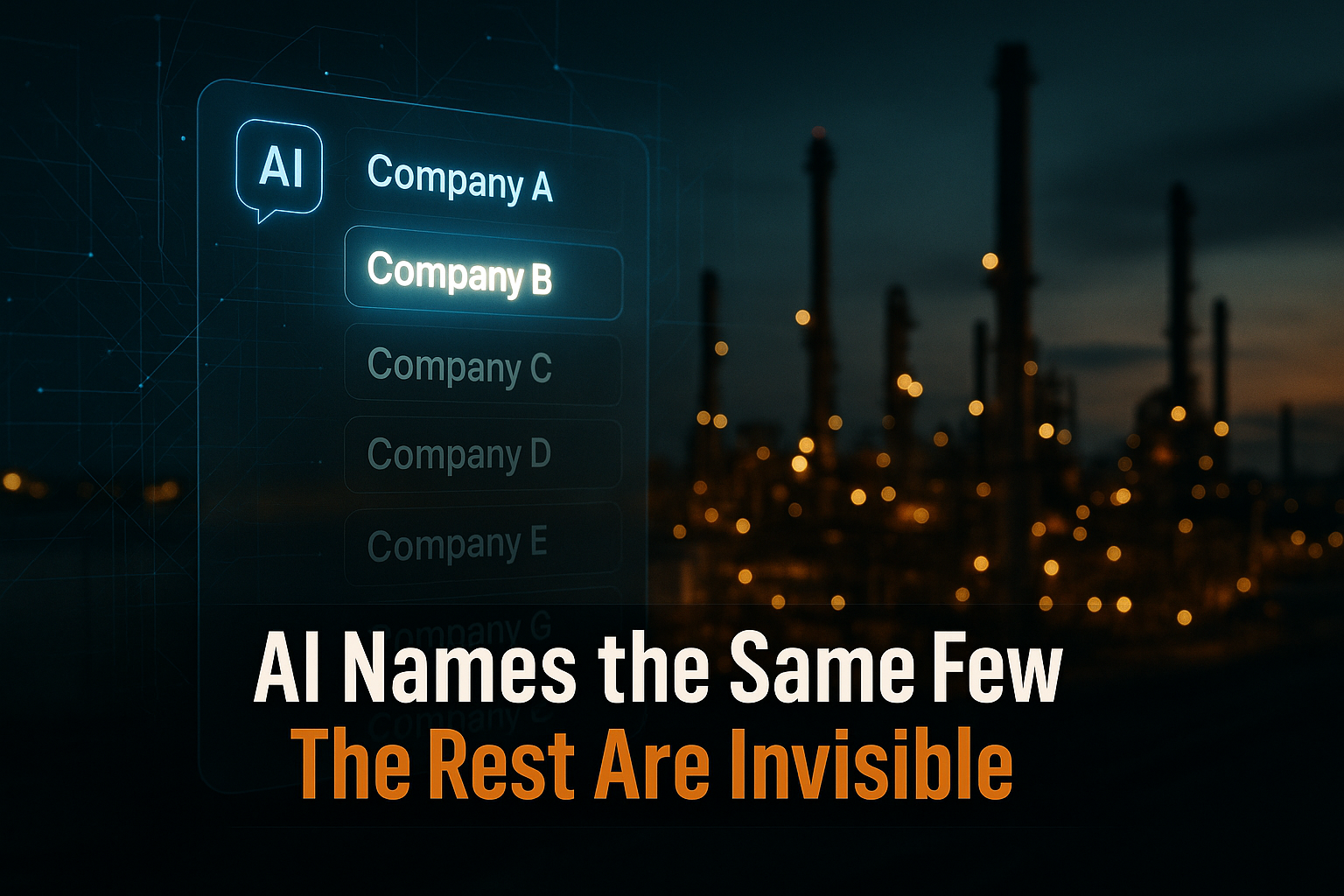
Ask ChatGPT, Claude, or Gemini who a buyer should hire for a job in oil and gas. A completions program. Produced-water handling. A gas-processing dedication. Power for a data center. You get back the same handful of big names almost every time, and most of the companies actually fighting for that work never come up.
I got curious enough about this to stop guessing and measure it. A few weeks of running real buyer questions past the assistants and reading what came back. The pattern was consistent enough that I started calling it the invisible middle, and the name has stuck.
What the invisible middle is
Every part of this industry has its anchors. The majors, the biggest service and midstream names, the research houses everybody already knows. Put a buying question to an assistant and those anchors show up, which is exactly what you’d expect.
The part that got my attention is how fast everyone else falls off a cliff. There’s a deep bench under the anchors: mid-market and emerging companies with real customers, real track records, and often a sharper answer to the actual problem than the giant that got named. In the answers the assistant returns, a big chunk of that bench isn’t ranked low. It’s just not there. And these aren’t marginal firms. This is where a lot of the revenue and most of the real competition in the sector lives.
Why this matters now
The front of the buying process moved, and most vendors haven’t clocked it. A procurement lead building a shortlist, an engineer scoping a vendor, an exec doing a first pass on a category, more of them open an assistant before they open a browser. It hands back a few names. Those names become the shortlist, and that happens before anyone on your sales team knows the deal exists.
So if you’re in the invisible middle, none of your marketing gets a swing at the ball. You’re not losing on price or on capability. You’re losing before the evaluation starts, because you were never in the set the buyer got handed. The brutal part is that it never shows up in a funnel report. The buyer who bounced off the AI’s shortlist never arrives on your site to be counted, so the number that would tell you this is happening doesn’t exist.
Why the engines name who they name
They’re not playing favorites. An assistant builds its answer out of what the open web says about a company, weighted toward the sources it trusts. I pulled the citations behind these answers to see where they actually came from, and the list is dull: regulatory filings, the big wire services, established trade press, a few reference and company-data sites. Anchors win the answers because anchors own those sources. They file more, get covered more, and get described the same way in more places.
That’s also the good news, and it’s why I don’t think this is hopeless for anyone stuck on the wrong side of it. Visibility here is something you can work, not a popularity contest you’re doomed to lose. If the engines pull from a knowable set of sources, then being present and consistent in those sources is the job. Researchers are mapping this under the name generative engine optimization, and the GEO paper is a decent place to start. It sits next to a related headache: whether the AI even describes your company correctly, which is the kind of thing the NIST AI Risk Management Framework is trying to name.
What I’d do about it
First, find out where you stand. Don’t ask “who is my company,” because that hands the assistant the answer. Ask what your buyers ask. Who should I shortlist for this. What are the alternatives to that anchor. Map this part of the market. Then check two things: whether you show up at all, and if you do, whether the engine gets you right.
Second, work the sources, not the brochure. The companies that surface are the ones described the same way by more than one credible outside party, in the places engines already lean on. That’s corroborated presence, and another landing page won’t buy it. For energy specifically, this is where my colleagues at EWR Digital spend more and more of their time, because it’s turned into a place deals quietly get decided.
And because I didn’t want to keep arguing from anecdotes, we built a way to measure it. ModalPoint is standing up an Energy AI Visibility Index: a repeatable read on how the answer engines represent energy companies when buyers ask real purchasing questions, segment by segment, every claim tied back to a recorded, dated answer. The early runs say what you’d guess from everything above. Anchors everywhere. A real slice of the middle nowhere. Full findings publish this quarter.
The uncomfortable part
Being good at what you do and being findable by an AI have split into two different things, and the second one now comes first. You can be the right answer to a buyer’s question and never get offered as one. For most of the invisible middle, this isn’t a problem they’re choosing to ignore. It’s one they can’t see, because the buyer who never made their shortlist never showed up in their data either. So go look. Ask the assistants what your customers are asking, and find out whether you’re even in the conversation.
Matthew Bertram is Chief Marketing Officer of OGGN, President of ModalPoint, and CEO of EWR Digital.